
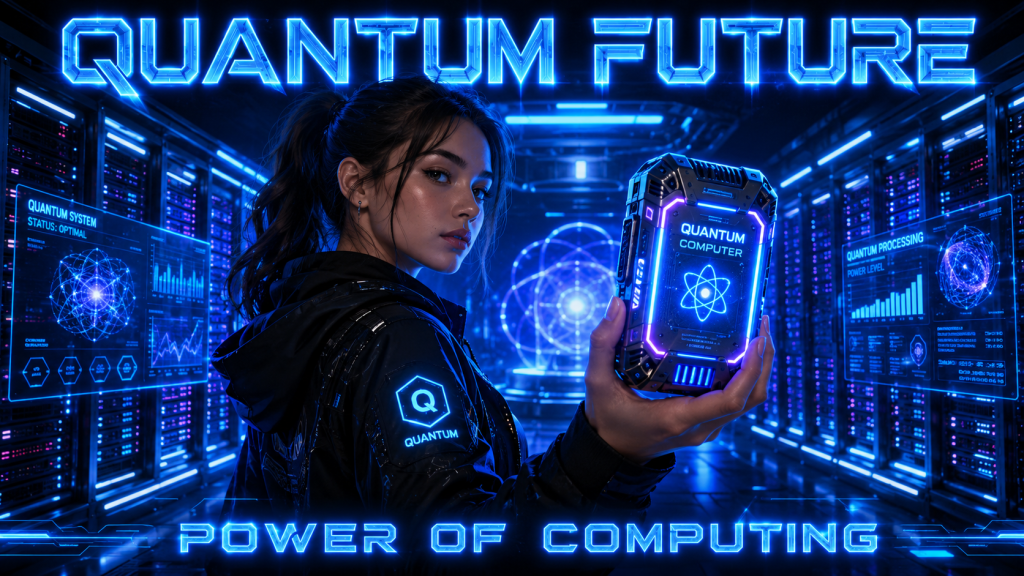
Quantum Computing and the Future of Miniaturized Superintelligent Systems
Toward Portable Quantum Devices and Quantum-Centric Supercomputing
Quantum computing represents one of the most significant scientific and engineering revolutions since the invention of the transistor. While classical supercomputers rely on billions of transistors switching between binary states (0 and 1), quantum computers exploit the laws of quantum mechanics—superposition, entanglement, and interference—to process information in fundamentally different ways. Researchers increasingly view quantum systems not as replacements for classical computers, but as specialized accelerators capable of solving problems that are effectively impossible for traditional architectures.
The next major technological transition may involve the miniaturization and democratization of quantum computing. Similar to how room-sized computers evolved into smartphones and wearable devices, scientists are now exploring methods to shrink quantum technologies into scalable, energy-efficient systems. The long-term vision includes portable quantum processors embedded into handheld devices, scientific instruments, autonomous systems, and potentially wearable technologies such as smartwatches.
1. Foundations of Quantum Physics and Quantum Computing
Quantum computing originates from the principles of quantum mechanics developed during the early twentieth century by physicists such as Albert Einstein, Niels Bohr, Werner Heisenberg, and Erwin Schrödinger.
Unlike classical bits, quantum bits—or qubits—can exist in multiple states simultaneously through superposition. This allows quantum systems to evaluate many possible outcomes in parallel.
A simplified representation of quantum superposition is:
∣ψ⟩=α∣0⟩+β∣1⟩
This equation describes a qubit existing in a probabilistic mixture of 0 and 1 simultaneously.
Quantum entanglement further enables qubits to share correlated states instantaneously across distances. These properties collectively allow certain algorithms to achieve exponential or near-exponential acceleration compared with classical methods.
Researchers believe this capability will revolutionize:
- molecular simulation
- pharmaceutical discovery
- cryptography
- logistics optimization
- weather modeling
- AI acceleration
- materials science
- fusion-energy simulation
- financial modeling
According to IBM Quantum, modern quantum systems are increasingly being integrated with classical supercomputers into what IBM calls “quantum-centric supercomputing.”
2. The Evolution from Supercomputers to Quantum-Centric Systems
Modern supercomputers already perform at exascale levels, executing quintillions of calculations per second. However, classical architectures encounter physical limitations involving:
- transistor scaling
- thermal dissipation
- memory bottlenecks
- energy consumption
- simulation complexity
Quantum processors bypass many of these constraints by operating within quantum state spaces that grow exponentially with qubit count.
Researchers describe the computational scaling advantage as:
2n
Where n represents the number of qubits. Each additional qubit doubles the accessible computational state space.
This exponential scaling explains why even relatively small quantum systems may eventually outperform classical supercomputers for specialized tasks.
IBM Research Quantum Hardware states that the future of computing will involve modular architectures combining quantum processing units (QPUs) with classical infrastructures.
3. Scientific Evidence that Quantum Computing Is Shrinking
One of the strongest scientific indicators supporting future portable quantum systems is the ongoing miniaturization of quantum hardware components.
3.1 Silicon-Based Quantum Chips
Traditional quantum computers often require extremely large cryogenic systems. However, newer approaches increasingly use silicon transistor fabrication methods similar to modern semiconductor manufacturing.
In 2026, the company Quantum Motion announced major advances using standard silicon transistors to create qubits. Reuters reported that researchers successfully adapted conventional transistor technologies for scalable quantum systems.
This development is important because silicon manufacturing already supports extreme miniaturization at nanometer scales.
If quantum processors can be fabricated similarly to smartphone processors, future reductions in size become technologically plausible.
3.2 Integrated Photonic Quantum Computing
Another major breakthrough involves photonic quantum systems.
Researchers publishing in npj Quantum Information demonstrated four-qubit variational algorithms using integrated silicon photonics and entangled photon sources directly embedded into compact chips.
Photonic quantum computing is especially promising because:
- photons generate less heat
- optical systems can operate at room temperature
- photonic circuits can be integrated onto semiconductor wafers
- miniaturization resembles modern fiber-optic communications
This suggests future quantum processors may become far smaller than today’s refrigerator-sized systems.
3.3 Cryogenic CMOS Electronics
One major obstacle in quantum computing is control electronics. Quantum systems require extremely sensitive signal control.
IBM Research Cryogenic CMOS describes the development of cryogenic CMOS electronics designed specifically for scalable quantum systems.
These technologies aim to:
- reduce wiring complexity
- reduce power consumption
- shrink control infrastructure
- integrate quantum processors with semiconductor technologies
Historically, shrinking control electronics was essential for transforming early computers into personal devices.
The same trend is now occurring in quantum engineering.
4. Quantum Supercomputers and Future Processing Power
Scientists increasingly predict that fault-tolerant quantum systems will exceed current supercomputers in selected computational domains.
IBM Quantum Roadmap describes IBM’s projected “Starling” system, expected to execute computational operations vastly beyond current systems. IBM estimates the computational state would require more memory than all classical supercomputers combined could realistically simulate.
Theoretical models suggest future quantum systems could:
- accelerate AI model training
- simulate entire molecular structures
- optimize planetary-scale logistics
- enhance autonomous robotics
- perform rapid cryptographic analysis
- revolutionize climate prediction
Importantly, quantum systems are unlikely to replace laptops or smartphones for ordinary tasks such as browsing or word processing. Instead, they will function as specialized accelerators integrated into hybrid systems.
5. Can Quantum Computers Become Handheld?
5.1 The Engineering Challenge
Current quantum computers often require:
- temperatures near absolute zero
- vibration isolation
- electromagnetic shielding
- vacuum chambers
These requirements currently prevent wearable or handheld deployment.
However, history demonstrates that transformative miniaturization frequently follows major breakthroughs.
Early classical computers once occupied entire buildings. Today, smartphones outperform many historical supercomputers.
5.2 Scientific Trends Supporting Miniaturization
Several research directions suggest portable quantum technologies may eventually emerge:
Silicon spin qubits
Use standard semiconductor processes.
Photonic quantum systems
Potential room-temperature operation.
Neutral atom architectures
Compact low-power modular systems.
Quantum cloud integration
Hybrid remote quantum processing through lightweight client devices.
This means future “quantum handhelds” may not contain full-scale quantum systems internally. Instead, compact local quantum accelerators may connect to distributed quantum cloud infrastructures.
6. Quantum Computing as a Household Technology
Quantum computing may eventually become invisible to ordinary users, similar to modern AI systems embedded into phones and appliances.
Potential household applications include:
- real-time medical diagnostics
- advanced AI assistants
- ultra-secure communications
- instantaneous language translation
- molecular food analysis
- personalized drug simulation
- autonomous transportation coordination
- real-time climate prediction
Researchers already describe the future as “ubiquitous, frictionless quantum computing.”
This transition mirrors the historical movement from industrial mainframes to consumer electronics.
7. Limitations and Scientific Realism
Despite rapid progress, significant obstacles remain.
Major challenges include:
- decoherence
- qubit instability
- error correction overhead
- manufacturing complexity
- cryogenic requirements
- energy costs
Many experts emphasize that useful fault-tolerant systems may require millions of physical qubits.
Therefore, claims of smartwatch-sized universal quantum computers remain speculative rather than imminent scientific reality.
However, miniaturized specialized quantum accelerators are scientifically plausible over long-term development cycles.
8. Conclusion
Quantum computing represents the next major leap in computational evolution. Scientific evidence already demonstrates clear progress toward scalable and increasingly compact architectures through:
- silicon-based qubits
- photonic quantum chips
- cryogenic CMOS integration
- modular quantum systems
- hybrid quantum-cloud infrastructure
Although current systems remain large and experimentally demanding, the historical trajectory of computing strongly suggests continued miniaturization.
The long-term future may involve portable quantum-enhanced devices possessing computational capabilities unimaginable today. Just as classical computing evolved from room-sized machines into wearable technology, quantum computing may eventually transition from laboratory infrastructure into everyday consumer tools.
The convergence of quantum physics, semiconductor engineering, artificial intelligence, and nanotechnology may ultimately redefine the limits of human computation itself.
Leave a Reply
You must be logged in to post a comment.