The Ecology of Shared Knowledge: Human Growth, Collective Intelligence, and the Possibility of a Post-War Civilization
Abstract
The act of sharing knowledge has historically served as one of humanity’s most transformative behaviors. From oral traditions in early tribal societies to globally connected digital infrastructures, knowledge exchange has enabled technological innovation, social cooperation, moral development, and cultural continuity. This paper examines how sharing knowledge contributes to individual psychological growth and collective societal evolution. Drawing from philosophy, cognitive science, sociology, and systems theory, it argues that knowledge-sharing strengthens empathy, expands consciousness, and creates resilient social networks capable of reducing violence and preventing large-scale conflict. Furthermore, this paper presents a prognosis for humanity’s future, proposing that while war has historically appeared inevitable, advancements in interconnected communication, education, decentralized collaboration, and collective awareness may ultimately render war obsolete. Humanity now stands at a transitional threshold: either fragmentation through fear and competition, or planetary maturity through shared understanding.
Introduction
Human civilization is fundamentally built upon inherited knowledge. Every scientific discovery, artistic movement, ethical framework, and technological advancement exists because information was preserved and transmitted across generations. Unlike isolated biological evolution, human progress occurs cumulatively through communication. The individual human being is therefore not merely a biological organism, but a participant in an ongoing informational continuum.
The digital age has accelerated this process beyond historical precedent. Today, a single idea can influence millions within hours. Knowledge no longer belongs solely to institutions, governments, or elite scholars; it increasingly exists within decentralized networks where creators, educators, artists, and communities collectively shape public consciousness.
This transformation raises an essential question: what happens when humanity chooses to share knowledge not merely for profit or power, but for collective elevation?
The answer may determine the future trajectory of civilization itself.
Knowledge Sharing and Individual Human Growth
Cognitive Expansion Through Teaching
Modern cognitive science demonstrates that teaching others enhances one’s own understanding. The “protégé effect” suggests that individuals who explain concepts to others develop deeper comprehension and stronger memory retention than those who study passively. Knowledge-sharing transforms information into integrated wisdom.
When individuals communicate ideas, they are required to:
- organize thought coherently,
- evaluate internal assumptions,
- refine conceptual understanding,
- empathize with alternative perspectives.
This process develops metacognition — the ability to think about one’s own thinking — which is a critical component of intellectual maturity.
The philosopher Socrates emphasized dialogue as the pathway to truth. Knowledge, in this framework, is not static possession but dynamic interaction. Growth emerges through exchange.
The Psychological and Ethical Dimensions of Sharing
Human beings derive meaning through contribution. Psychological research consistently links altruistic behavior with increased life satisfaction, emotional resilience, and social connection. Sharing knowledge can therefore be understood not only as an intellectual act but also as a moral and existential one.
When individuals openly share skills, experiences, or insights:
- social trust increases,
- collective anxiety decreases,
- collaboration becomes normalized,
- hierarchical fear structures weaken.
Knowledge-sharing undermines the scarcity mindset that often fuels social division. If information is abundant, cooperation becomes more valuable than domination.
This has profound implications for civilization.
Collective Intelligence and the Evolution of Society
Humanity as a Networked Organism
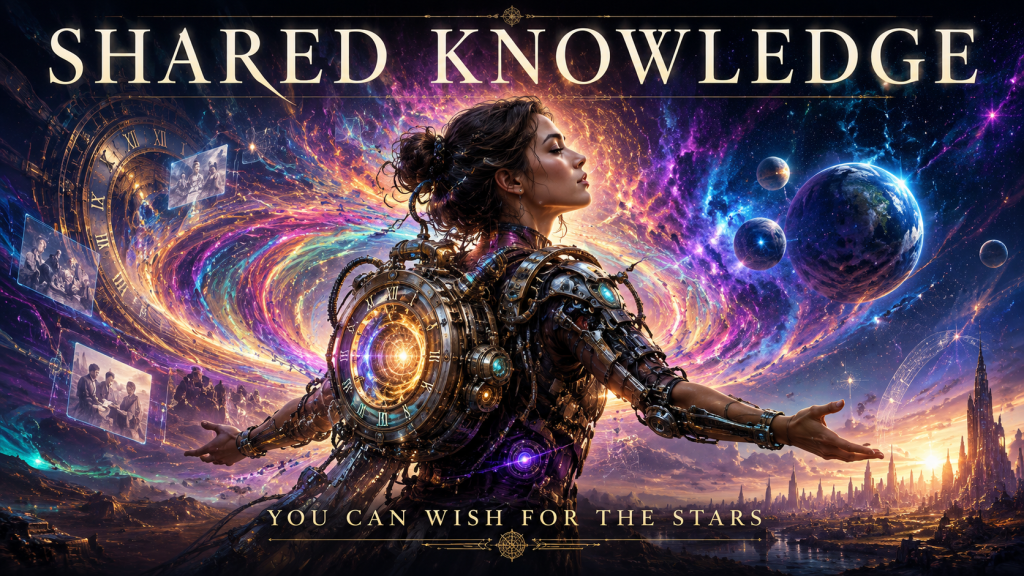
The internet represents more than a technological invention; it is the early architecture of a planetary nervous system. Billions of humans now participate in a real-time exchange of information, emotion, culture, and ideology.
Collective intelligence emerges when decentralized individuals contribute knowledge toward shared goals. Open-source software communities, scientific collaborations, and global educational platforms demonstrate how distributed cooperation can outperform isolated competition.
Examples include:
- collaborative medical research,
- open educational resources,
- decentralized creative communities,
- global crisis response networks.
These systems reveal a critical truth: intelligence scales through connection.
Historically, empires centralized information to maintain power. The future may invert this model entirely, distributing knowledge horizontally rather than vertically.
War as a Consequence of Informational Fragmentation
Wars rarely emerge solely from biological aggression. More often, they arise from:
- ideological manipulation,
- economic scarcity,
- misinformation,
- tribal identity structures,
- dehumanization of perceived “others.”
In many cases, conflict depends upon limiting perspective. Populations become easier to mobilize toward violence when isolated from alternative narratives.
Shared knowledge directly challenges these mechanisms.
When people communicate across borders, cultures, and belief systems:
- empathy increases,
- propaganda weakens,
- common human experiences become visible,
- collective interests emerge more clearly.
Digital communication has already altered geopolitical reality. Younger generations increasingly identify with global culture in addition to national identity. Artists, scientists, gamers, creators, and educators now form transnational communities that operate independently of historical borders.
This does not eliminate conflict immediately, but it fundamentally changes the conditions under which conflict develops.
The Prognosis for Humanity
Phase I: The Age of Information Saturation
Humanity currently exists within a paradoxical stage. Information abundance coexists with psychological fragmentation. While access to knowledge has expanded dramatically, misinformation and algorithmic polarization have also intensified.
This transitional period is unstable.
Artificial intelligence, automation, and digital media are rapidly restructuring:
- labor systems,
- education,
- governance,
- social identity,
- creative production.
The next several decades will likely determine whether humanity evolves toward cooperative intelligence or descends into technologically amplified tribalism.
Phase II: Emergence of Planetary Consciousness
Despite current instability, several long-term trends suggest the emergence of a more interconnected civilization:
1. Global Education Expansion
Access to educational material is increasing exponentially. Future generations will possess unprecedented access to scientific, philosophical, and cultural knowledge.
2. Decentralized Collaboration
Communities increasingly self-organize outside traditional institutions. Open-source ecosystems and distributed networks reduce dependency on centralized authority.
3. Cultural Hybridization
As communication barriers dissolve, cultures increasingly influence one another creatively rather than militarily.
4. AI-Assisted Knowledge Distribution
Artificial intelligence may eventually democratize expertise itself, making advanced education and problem-solving universally accessible.
These developments collectively encourage interdependence rather than isolation.
Can War Truly Be Eradicated?
Absolute certainty is impossible. Human psychology still contains aggression, fear, and competition. However, war may become increasingly irrational within highly interconnected societies.
Historically, slavery, monarchy by divine right, and public executions were once considered permanent features of civilization. Over time, moral evolution transformed social norms previously regarded as inevitable.
War may undergo a similar transformation.
Several conditions would accelerate this process:
- universal access to education,
- transparent information systems,
- reduction of extreme economic inequality,
- intercultural communication,
- ethical technological governance,
- collective ecological responsibility.
The survival pressures of climate change, resource instability, and global technological risk may ultimately force humanity toward unprecedented cooperation.
In this sense, peace may not emerge from idealism alone, but from necessity.
The Role of Art and Knowledge Platforms
Creative platforms such as revolluci.art represent more than digital galleries or publishing spaces. They can function as cultural catalysts — environments where ideas, aesthetics, philosophy, and emotion converge into shared human experience.
Art communicates where political language often fails.
A single image, essay, or concept can:
- dissolve psychological distance,
- provoke introspection,
- inspire empathy,
- challenge inherited assumptions,
- reveal hidden dimensions of human identity.
The future of civilization may depend not only on technological advancement, but on humanity’s ability to cultivate wisdom alongside intelligence.
Knowledge without empathy creates efficient destruction.
Knowledge shared with consciousness creates evolution.
Conclusion
Human growth is inseparable from the exchange of knowledge. Individuals evolve through teaching, dialogue, and collaborative understanding, while societies progress through the preservation and transmission of collective intelligence.
Although conflict remains deeply embedded within human history, history itself demonstrates that civilization is capable of moral transformation. The expansion of global communication, decentralized education, and interconnected cultural systems may gradually weaken the structural foundations of war.
Humanity now faces a civilizational choice:
to weaponize knowledge for domination,
or to distribute knowledge for collective awakening.
If the future belongs to shared intelligence rather than isolated power, then war may one day be remembered not as humanity’s destiny, but as a primitive stage of consciousness eventually surpassed.
The next chapter of civilization will not be written solely by governments or institutions.
It will be written by those willing to share what they know.
Leave a Reply
You must be logged in to post a comment.