Randy Daha / Revolucci
A History of the Artist, the Alias, and the Visual Language
Randy Daha’s creative identity lives in two names. One is the person: Randy Daha, the maker, observer, image-builder, and visual storyteller. The other is the signal: Revolucci. Not simply a username, not simply a brand, but an alter ego built for movement — an artist-name that sounds like revolution, street culture, cinema, design, and personal mythology all at once.
Revolucci began as the kind of identity that could only fully make sense online: part avatar, part signature, part mask, part studio name. On platforms like DeviantArt, where artists often developed themselves through aliases, galleries, favourites, watchers, comments, and visual communities, Revolucci became a recognizable handle — a presence moving through a network of illustrators, photographers, poets, digital artists, hobbyists, and underground image-makers. Public DeviantArt traces show the account active in that ecosystem, interacting with other users, leaving thanks, watching artists, and appearing in community lists.
That matters because DeviantArt was never just a portfolio site. For a generation of visual makers, it functioned like an open studio, sketchbook, mood board, classroom, fan club, archive, and underground gallery at the same time. It rewarded presence as much as polish. It allowed artists to build a name by looking, collecting, responding, posting, commenting, remixing influences, and slowly developing a recognizable eye. Revolucci belongs to that lineage: the artist as participant, not isolated genius; the artist as witness, collector, supporter, and builder of visual culture.
The Origin of the Alter Ego
The name Revolucci carries a double charge. “Revo” suggests revolt, revolution, reversal, renewal. “Lucci” gives it rhythm, personality, a streetwise signature. Together, the name feels like a tag: short enough to remember, stylized enough to belong on a cap, a poster, a screenprint, a sticker, or the corner of an image.
As an alter ego, Revolucci gives Randy Daha permission to operate in a heightened visual register. Randy can be the human being behind the work; Revolucci can be the symbol that steps into the artwork. That symbol can be louder, sharper, more cinematic. It can carry swagger, discipline, tenderness, humour, critique, and self-mythology without needing to explain itself every time.
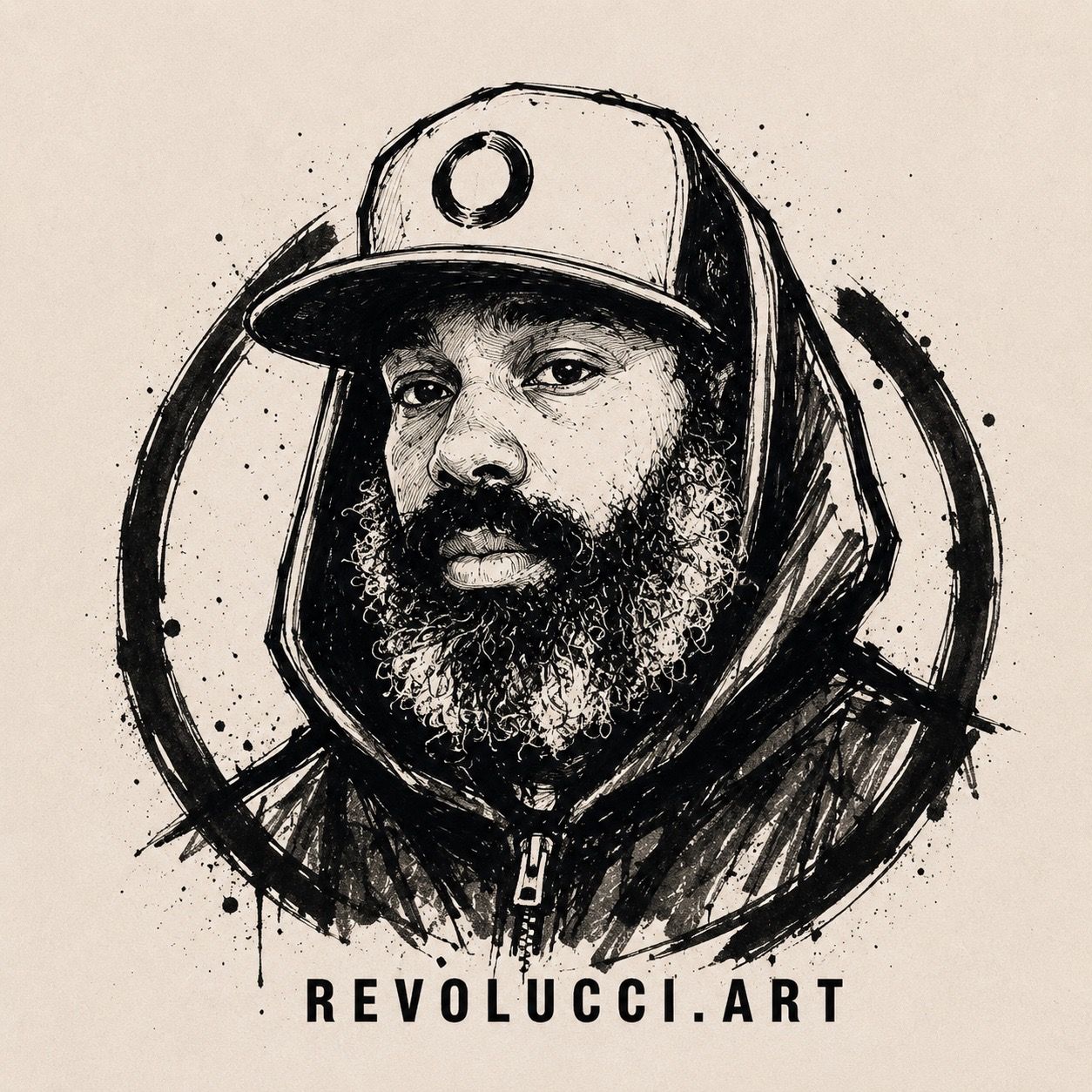
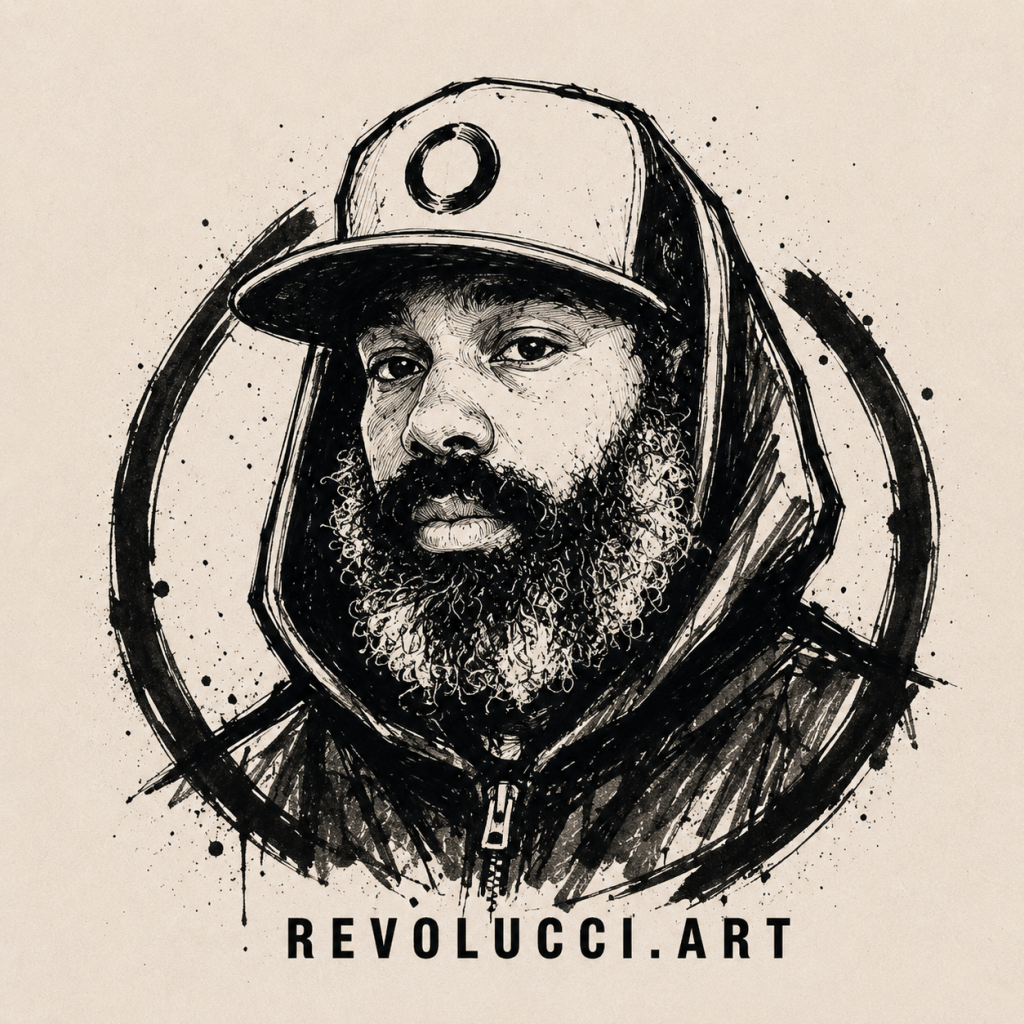
This is why the supplied imagery works so strongly. The repeated figure — hoodie, cap, beard, direct gaze, studio equipment, notebooks, screens, microphones, books, posters, cameras, AI tools, speakers, and slogans — is not just a portrait. It is a mythology system. It shows Revolucci as the artist at work, the director in the room, the storyteller, the gallery host, the poet, the designer, the cultural worker, the man with the archive in his hands.
DeviantArt: The First Public Territory
The DeviantArt era should be understood as Revolucci’s first public territory: not necessarily the beginning of Randy’s creativity, but the place where the alter ego could exist socially.
On DeviantArt, a name becomes real through repetition. A profile avatar appears. A comment is left. A favourite is given. A watcher list grows. A style is tested. The artist is not only what they upload, but also what they choose to look at, who they support, and what kind of visual world they keep returning to.
Indexed DeviantArt pages show Revolucci as an account present in other artists’ spaces: watching, favouriting, and commenting. These fragments are small, but they are exactly the kind of traces that define an early online art identity. They show Revolucci not as a detached brand launched fully formed, but as a living participant in an art community.
This history is important for the website because revolucci.art should not feel like a clean corporate portfolio. It should feel like an archive that grew out of online art culture: messy, visual, generous, layered, personal, and alive.
From Username to Visual Persona
Over time, Revolucci appears to have shifted from being simply a digital handle into something broader: a persona with its own visual grammar.
The strongest current visual language is black ink on paper: scratchy, graphic, handmade, cinematic, slightly raw. It carries the energy of sketchbooks, underground comics, hip-hop posters, street flyers, zines, tattoo flash, animation concept art, and documentary photography. The linework is imperfect in the right way. It feels touched, dragged, scraped, corrected, repeated. That roughness is part of the authority.
In the current imagery, Revolucci is shown in several roles:
The studio thinker, seated at a desk with sketches, layout grids, typography, books, monitors, and brand strategy objects around him.
The film person, surrounded by cameras, clapperboards, posters, popcorn, reels, and the repeated language of story, vision, and impact.
The AI-era artist, working with screens, prompt panels, character studies, ethical AI notes, and digital drawing tools.
The speaker / poet, standing at a microphone, holding a book, addressing an audience through language and presence.
The symbolic portrait, framed by a circular mark and the name REVOLUCCI.ART, turning the face into an emblem.
This is a mature alter ego. It is no longer only “Randy online.” It is Randy translated into a public creative mythology.
The Core Themes
Revolucci’s world revolves around a few repeating themes.
Story.
The work is not only decorative. It points toward narrative: films, characters, books, poems, posters, scenes, and emotional fragments. Even the studio objects in the images feel like props from a larger story.
Vision.
Revolucci is presented as someone who sees before he makes. Screens, cameras, notebooks, and sketches keep returning as symbols of observation and direction.
Impact.
The phrase “Story / Vision / Impact” appears as a kind of manifesto. The implication is clear: art should land somewhere. It should affect the viewer, shape memory, communicate feeling, or shift perception.
Respect.
The ethical imagery matters. One of the supplied visuals includes a wall-like system with “Respect” and an “Ethical AI” panel. That places Revolucci not only inside art-making, but inside a moral conversation about tools, people, fairness, inclusivity, transparency, kindness, and creativity.
Ideas shape worlds.
This is the central slogan. It works because it is simple and large enough to hold the entire project. Revolucci is not just making images; he is building worlds through images.
The Art Practice
The Revolucci practice should be presented as a hybrid practice: visual art, digital culture, poetry, graphic design, storytelling, and archive-building.
The articles on revolucci.art should therefore not behave like normal blog posts. They should behave like gallery rooms. Each post can contain images, sketches, fragments, process notes, poems, captions, statements, and visual experiments. The artwork is the main body, but the text is not secondary. The text is the voice inside the gallery.
That is why the website direction is right: the template should be a horizontal gallery slider with categories as rooms. Each category should feel like a wall, a collection, or a chapter. Each article should open like an exhibition: image-heavy, lightbox-enabled, with the writing also treated as something to be read in focus.
For Revolucci, text is not filler. Text is part of the artwork. Poetry, titles, slogans, captions, and notes are all image-objects in their own right.
Revolucci and the NYA Network
The current site also sits inside a larger cultural network. NotYouAgain.ai publicly lists revolucci.art among client/collaborator or network projects, describing it in relation to “Streetknowledge” and “street-level projects and visual language.”
That positioning is useful. Revolucci should not be framed as a generic “artist portfolio.” It is better understood as a street-level visual-language archive: a place where illustration, portraiture, poetry, digital tools, urban culture, and personal mythology meet.
In that sense, revolucci.art can become the formal home of something that began informally: the alias, the eye, the comments, the favourites, the sketches, the visual fragments, the online identity, the studio persona, and the artwork all brought together into one living archive.
The Present Chapter
The present Revolucci chapter is about consolidation.
The old online identity is becoming a proper art platform. The DeviantArt-era presence becomes history. The supplied black-and-white portrait system becomes the new visual anchor. The website becomes a horizontal gallery, not a conventional scroll. Categories become exhibition rooms. Posts become artwork dossiers. Images open in lightboxes. Poetry opens in reading panels. Text becomes part of the exhibition.
This is the correct evolution: from username to archive, from archive to gallery, from gallery to mythology.
Revolucci is now positioned as:
An artist of visual language.
A storyteller working through images.
A street-level designer of moods, marks, and meanings.
A poetic archive-builder.
A figure shaped by online art culture but no longer limited by it.
Short Website Bio Version
Randy Daha, known online as Revolucci, is a visual artist and storyteller whose work grew out of the open, experimental culture of online art communities such as DeviantArt. Under the Revolucci name, he developed an alter ego that functions as both signature and creative mask: part artist, part director, part poet, part street-level visual archivist.
His work combines illustration, portraiture, digital culture, poetry, graphic design, and cinematic worldbuilding. The Revolucci visual language is raw, black-and-white, ink-driven, and immediate — built from sketchbook energy, studio objects, street culture, handwritten slogans, and the belief that ideas shape worlds.
Revolucci.art is the living archive of that practice: a gallery of images, writings, fragments, experiments, and visual stories.
Museum Label Version
Randy Daha / Revolucci
Visual artist, storyteller, and online-era image-maker.
Known through the alias Revolucci, Randy Daha developed a visual identity rooted in digital art culture, DeviantArt-era community exchange, street-level aesthetics, poetry, and graphic storytelling. His work moves between portrait, poster, sketch, studio diary, and cinematic worldbuilding. Revolucci is both the artist’s name and his alter ego: a public-facing creative symbol for vision, discipline, respect, and impact.
Homepage Intro Version
REVOLUCCI.ART is the visual archive of Randy Daha — artist, storyteller, poet, image-maker, and the creative force behind the Revolucci alter ego.
Born from online art culture and sharpened through years of visual exploration, Revolucci brings together ink, portraiture, poetry, digital tools, street knowledge, and cinematic imagination.
Story. Vision. Impact.
Ideas shape worlds.
Leave a Reply
You must be logged in to post a comment.